

Talent Management Software: Features, Costs & How to Choose in 2026
Talent management software helps organizations manage more than just hiring. Depending on the platform, it can support recruitment, onboarding, employee performance, learning and development, career growth, and succession planning, all in one system.
But not every business needs every feature. The right solution depends on your workforce size, HR processes, business goals, and the areas where your current system falls short.
This guide covers the key types of talent management software, the features worth evaluating, typical costs, and the factors to consider when choosing a platform in 2026.
What Is Talent Management Software?
Talent management software helps organizations attract, hire, develop, and retain employees across the employee lifecycle. Depending on the product, it may focus on a specific area, such as recruitment or performance management, or combine several HR processes within one platform.
That distinction is important when comparing solutions. An applicant tracking system (ATS), is primarily designed to manage candidates and hiring, while a performance management tool focuses on goals, feedback, and employee reviews.
A broader talent management suite may bring these functions together with onboarding, learning and development, employee engagement, and succession planning. Always check the modules included in a platform rather than assuming it covers every stage of talent management.
Most organizations evaluate talent management software across five key stages:
Hire: Job postings, candidate tracking, interviews, and offersOnboard: New-hire tasks, documentation, and role-specific trainingPerform: Goals, feedback, performance reviews, and progress trackingDevelop: Skills, learning programs, career paths, and employee growthPlan: Succession planning, workforce insights, and talent reporting
Which Type of Talent Management Tool Do You Need?
If hiring is your main bottleneck, start with an ATS. If reviews are inconsistent, look at performance software. If teams repeatedly copy employee data between hiring, onboarding, learning, and review tools, evaluate a broader platform or integrations between the tools you already use.
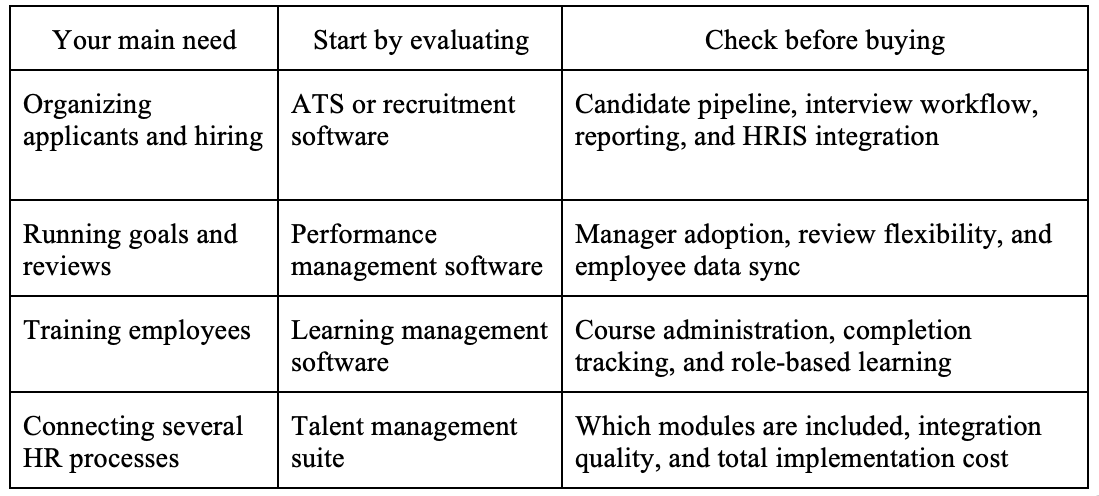
Wavenest’s recruitment and talent solution is most relevant to readers focused on hiring workflows. If you need performance, learning, or succession capabilities as well, ask which are available and how they would connect to your existing systems.
Core Features to Look For
Not every talent management platform needs every feature. A 40-person startup replacing a review spreadsheet needs less than a 3,000-person company managing global succession plans. These are the features that matter most across company sizes:
Recruitment and applicant tracking: job postings, candidate pipelines, interview coordination, and hiring reports.Performance management: continuous feedback, goal tracking (OKRs or similar), and structured review cycles instead of a once-a-year form.Learning and development: training paths and progress tracking connected to employees’ roles and development goals.Succession planning: a way to identify critical roles, potential successors, and development needs.Employee engagement surveys: feedback collection and reporting that helps teams identify issues to investigate.Structured onboarding: new-hire checklists, role-specific tasks, and manager accountability.Workforce analytics: reporting that brings relevant hiring and employee data together without repeated manual exports.
Talent Management Software vs Point Solutions
A suite brings several processes under one provider. Specialist tools let you select a separate product for each job. The better choice depends on the workflows you need, the integrations available, and the work required to maintain them.
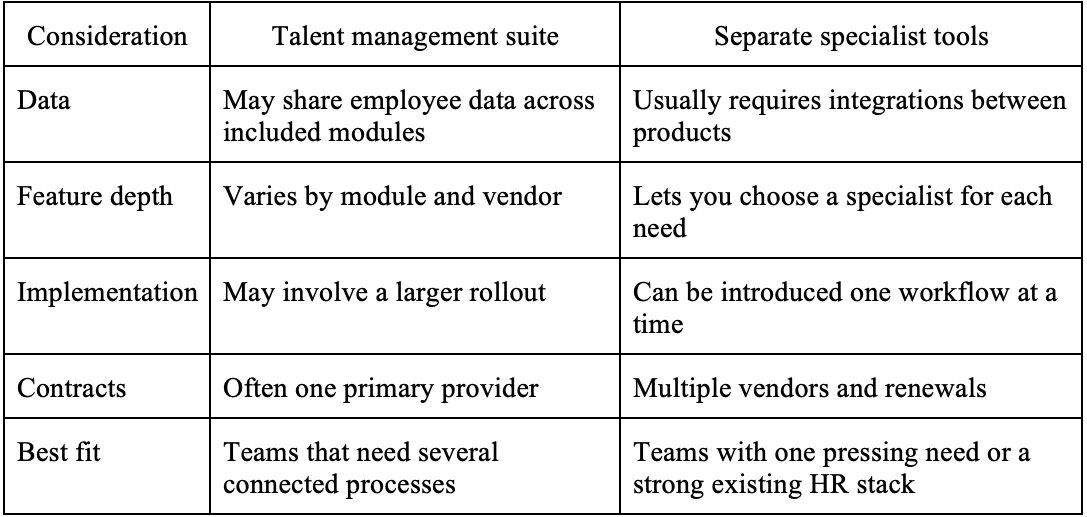
Ask each vendor to demonstrate a real workflow across systems—for example, moving a hired candidate into onboarding. That will tell you more than a feature checklist about how much manual work your team will still have to do.
How Much Does Talent Management Software Cost?
There is no single price for talent management software. Costs vary based on the modules you need, employee count, contract terms, implementation requirements, integrations, and support level. When comparing vendors, look at the total cost of ownership rather than the advertised subscription price alone.
Request an itemized quote covering:
Subscription: Pricing model, included modules, minimum fees, and contract lengthSetup: Configuration, implementation, and data migrationIntegrations: HRIS, payroll, SSO, and other required connectionsTraining: Administrator and manager trainingOngoing costs: Support, additional users or modules, and renewal terms
How to Choose Talent Management Software
Choosing talent management software comes down to matching the platform to the HR processes you actually run today, not the ones you hope to run someday. Map your current HR processes and identify where your existing tools or spreadsheets fall short.
- Prioritize essential features based on your actual HR goals rather than impressive demo features.
- Shortlist three suitable vendors based on company size, needs, budget, and scalability.
- Test the platform before buying by running a real workflow through a trial or sandbox.
- Check HRIS and payroll integrations to avoid duplicate data entry and disconnected systems.
- Compare pricing and total costs, including implementation, support, and additional modules.
- Evaluate ease of use and support for HR teams, managers, and employees.
- Run a small pilot with one department before rolling the software out company-wide.
- For teams that already use engagement surveys, our guide to choosing employee survey tools is a useful companion resource.
Common Mistakes When Implementing Talent Management Software
- Buying software before mapping HR processes
- Skipping manager training
- Migrating incomplete or inaccurate historical data
- Treating onboarding as a separate process
- Rolling out every module at once
- Ignoring employee adoption
- Failing to assign clear ownership
- Choosing features without considering actual business needs
The Next Step for Your Team
Write down the one HR workflow you most need to improve. If it’s recruitment, review the Wavenest recruitment and talent solution and request a demonstration of that workflow, from a new application through the hiring decision. If your priority is broader employee development or succession planning, ask which capabilities can be provided and connected to your current HR tools before committing to a platform.